Investing And House Hacking In Cambridge And Somerville
May 14, 2026
May 14, 2026
If you have looked at Cambridge and Somerville lately, you already know the challenge: prices are high, inventory can be tight, and the margin for error is small. The upside is that these are also two of Greater Boston’s most durable rental markets, which is why house hacking can be such a practical path for buyers who want to live in the property and offset costs over time. In this guide, you’ll see where the numbers support the strategy, what property types tend to fit best, and what to double-check before you buy. Let’s dive in.
Cambridge and Somerville share a lot of the ingredients that often support long-term rental demand. Both are dense, renter-majority markets with strong job access, high housing costs, and a large share of households that value transit and proximity to employment centers.
The data helps explain why these markets remain attractive for owner-occupant investors. Cambridge’s 2024 population estimate was 121,186, with density of 18,520.7 people per square mile and a 33.5% owner-occupied housing rate. Somerville’s 2024 population estimate was 82,149, with density of 19,656.8 people per square mile and a 34.2% owner-occupied rate.
Rent levels are also meaningful. Cambridge’s median gross rent was $2,787, and Somerville’s was $2,517. In Cambridge, 2025 Q3 market-rate asking rents were reported at $2,200 for studios, $2,785 for one-bedrooms, $3,400 for two-bedrooms, and $3,900 for three-bedrooms.
That does not mean every property will work as an investment. It does mean these cities offer the kind of rental demand profile that can make a well-bought owner-occupied property more compelling than it might look at first glance.
East Somerville deserves special attention if you are thinking about house hacking. The neighborhood now has direct Green Line Extension access through East Somerville station, and the city added a multi-use path next to the line between Lechmere and Magoun Square.
The city also designed the Glen Street and Otis Street neighborway to help connect the East Somerville station with the Broadway business district and Winter Hill. For a buyer, that kind of transit connectivity can matter a lot when you are evaluating rentability, daily convenience, and long-term demand.
In practical terms, access to rail and neighborhood connections can make a smaller multifamily or flexible condo more attractive to future tenants or roommates. In a dense urban market, location efficiency often carries real weight.
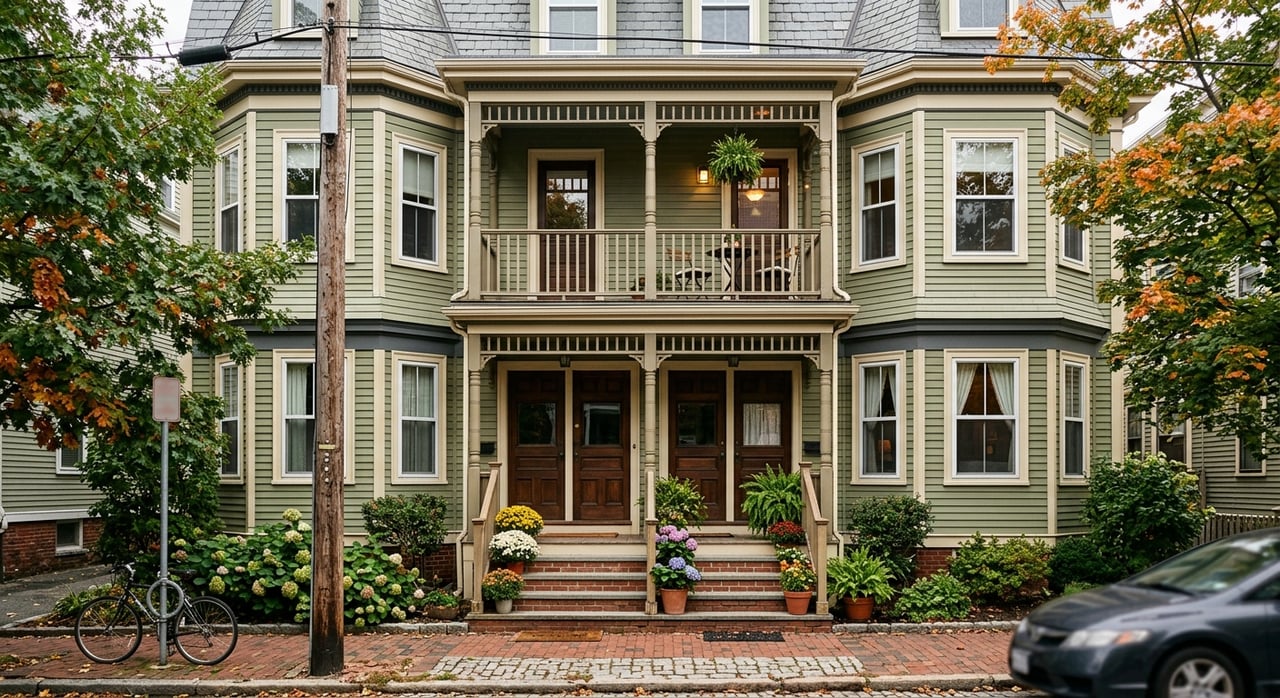
In both Cambridge and Somerville, the clearest house-hack strategy is still buying a small multifamily, living in one unit, and renting the others. This approach gives you the most direct rent offset and usually the clearest operating plan.
Somerville especially tends to fit this model well. According to the research, the most practical house-hack there is often an existing two- or three-family, or a condo with lawful room-rental upside.
Cambridge still offers strong small multifamily potential too, but the story has changed. A February 10, 2025 zoning overhaul now allows multifamily housing citywide in all districts except open space, which broadens the long-term possibilities for certain properties.
If a multifamily purchase is out of reach, a condo can still be part of a house-hack plan. The key is being careful and realistic about what the property legally allows.
Some buyers use a condo by living in the unit and renting an extra legal bedroom where rules permit. This can be useful in high-cost areas, but it is not something to assume from a listing sheet alone. You need to verify condo rules, occupancy limits, and unit configuration before counting on that income.
Accessory dwelling units are becoming more relevant in Massachusetts. State ADU regulations took effect on January 31, 2025, and the law allows ADUs under 900 square feet by right in single-family zoning districts statewide, subject to reasonable local regulation.
Cambridge separately states that accessory apartments are permitted in all zoning districts where residences are permitted. For buyers, that can expand the long-term value of a single-family purchase, especially if a basement, lower level, or rear addition may support an in-law or ADU configuration. Still, you need to review local dimensional rules, permitting, and code requirements on a property-by-property basis.
Cambridge is no longer just a market of older one-, two-, and three-family properties with fixed limits. Under the city’s 2025 zoning overhaul, the new Residence C-1 rules allow housing up to four stories, and up to six stories on lots of at least 5,000 square feet if 20% of the residential floor area is inclusionary housing.
The city also says zoning no longer sets a minimum lot size, maximum number of units, or maximum floor area for housing in Residence C-1. For buyers, that creates a different lens for evaluating certain properties, especially those with lot characteristics that might support future redevelopment or expansion.
That said, zoning is not the whole story. Building code, historic review, and permitting still apply, so you should treat redevelopment upside as a possibility to investigate, not a guarantee to price in automatically.
Somerville can still be very appealing for house hacking, but the playbook is often more about existing housing stock than future condo conversion. The city’s condo-conversion process is more regulated, and the Condo Review Board oversees that process.
Effective October 1, 2025, Somerville extended notice requirements and increased relocation payments in its condo-conversion ordinance. The city’s FY2026 tax update also says condo conversions have slowed because of stronger tenant-rights rules.
For you, the takeaway is simple: if your strategy depends on converting a property later, Somerville calls for extra caution. In many cases, a cleaner approach is buying an existing two- or three-family that already fits your goals.
High rents do not erase high acquisition costs, so you need to look at both sides of the equation. In Cambridge, 2024 median market-rate sale prices were $2,315,000 for single-family homes, $1,542,500 for two-families, $1,822,500 for three-families, and $870,000 for condominiums.
Cambridge’s FY26 property-tax update also showed a two-family median value of $1,648,750 with a $7,594 tax bill, and a three-family median value of $1,918,700 with a $9,395 tax bill. The FY26 residential tax rate is $6.67 per $1,000, and the residential exemption reduces assessed value by $510,208, producing tax savings of $3,403.
Somerville’s FY26 average values were $775,675 for condos, $1,187,364 for one-families, $1,193,941 for two-families, and $1,474,682 for three-families. Its FY26 residential tax rate is $10.98 per $1,000, and the 35% residential exemption yields up to $4,578 in savings.
These numbers matter because owner-occupant economics can look very different from a pure investor purchase. In both cities, the residential exemption can materially improve the monthly picture if you will live in the home.
Neither Cambridge nor Somerville behaves like a soft rental market. Cambridge’s housing stock is 66.5% renter-occupied, and Somerville’s FY2026 tax update explicitly says that 4-to-8-unit and 9-plus-unit apartment buildings are showing low vacancies.
Cambridge also reported 151,521 average monthly employees working in Cambridge-covered jobs in 2024, with especially large shares in professional and business services and in education and health services. That kind of employment base helps support renter demand across well-located housing types.
Still, a strong market does not protect you from a weak deal. In these cities, turnover management, layout quality, legal unit status, and transit access can matter as much as broad vacancy assumptions.
A Cambridge or Somerville house-hack should be evaluated as a regulated, high-cost, transit-oriented asset. Before you rely on future rental income or a later conversion plan, make sure you confirm the basics carefully.
This matters even more now because local rules have changed. Cambridge updated its multifamily zoning in 2025, Massachusetts changed ADU rules in 2025, and Somerville has stronger condo-conversion protections.
Short-term rental income is not a shortcut in these markets. In Cambridge, short-term rentals require registration, and the operator must live in the unit as a primary residence.
The city also says you may rent out up to three legal bedrooms. That means short-term rental income is a compliance-heavy strategy, not something you should casually use to justify a purchase.
If you are trying to build equity while controlling your monthly cost, Cambridge and Somerville can be compelling places to do it. The strongest setups are usually straightforward: an owner-occupied two- or three-family, a condo with lawful rental flexibility, or a single-family with realistic ADU potential.
Cambridge may offer more redevelopment flexibility after the 2025 zoning change. Somerville often offers a more existing-stock, buy-and-operate path, with extra care around tenant protections and condo conversion.
The best next step is not chasing a theoretical upside. It is identifying a property where the legal use, transit access, tax structure, and rent potential all line up with your timeline and risk tolerance.
If you are weighing a purchase in Cambridge or Somerville and want a clear, numbers-driven strategy, Taylor Yates can help you evaluate property type, location, and long-term flexibility with a concierge-level approach.
Stay up to date on the latest real estate trends.

Taylor Yates | September 21, 2026
September 17, 2026

Taylor Yates | September 14, 2026

September 10, 2026

Taylor Yates | September 7, 2026
September 3, 2026
August 27, 2026

Taylor Yates | August 24, 2026
August 20, 2026
We bring decades of experience to transactions large and small and treat every client with the high level of service they deserve. Whether your goal is to build, buy, or sell a home, I would be honored to serve and help you with your real estate needs!

426 Boston Post Rd. Weston, MA 02493