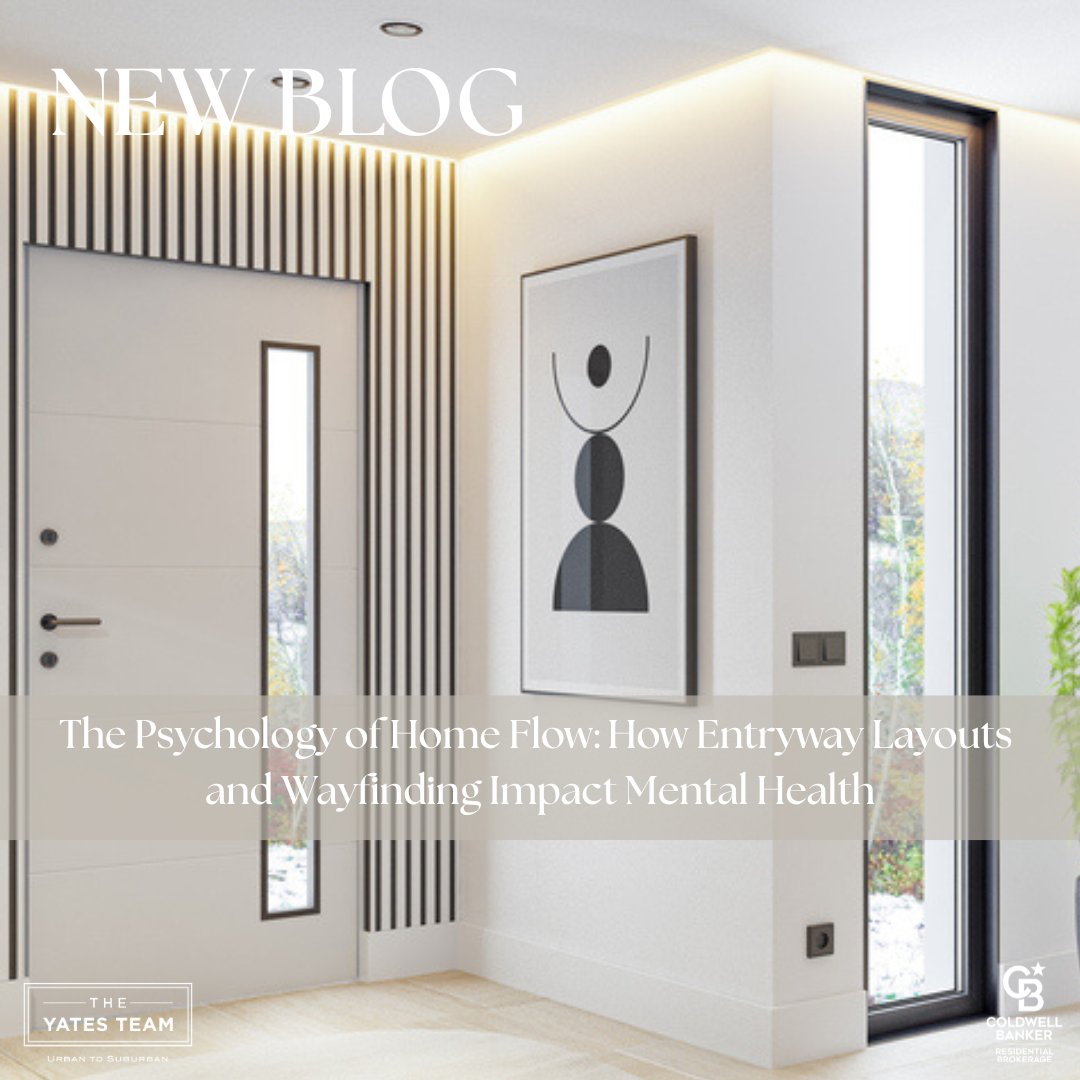
The Psychology of Home Flow: How Entryway Layouts and Wayfinding Impact Mental Health
Taylor Yates | February 9, 2026
Taylor Yates | February 9, 2026
Have you ever walked into a home and instantly felt at peace? Your shoulders drop, your mind clears, and you feel an effortless sense of belonging. This isn't just good decorating—it’s the psychology of flow.
In this blog, we explore how architectural "flow" mirrors the psychological state of being "in the zone." When a home is designed with intention, it doesn't just look beautiful; it functions as a catalyst for well-being.
First impressions aren't just for people; they apply to spaces too. In the podcast, we discuss the "First 10 Seconds" rule. This is the window of time it takes for your nervous system to decide if a home is a sanctuary or a source of stress.
An entryway layout that provides a clear place to land—a spot for your keys, a bench for your shoes, and a clear sightline into the home—signals to your brain that the "outside world" is over. If the entry is cluttered or cramped, your brain stays in a high-alert, transitional state, preventing you from ever truly relaxing.
Have you ever felt trapped or "stuck" in a specific room? This might be due to dead-end architecture. These are rooms with only one way in and out.
Psychologically, dead-end rooms can feel stagnant. They interrupt the "circuit" of a home's energy. While a bedroom or bathroom requires privacy, living spaces benefit from multiple points of entry. A room that allows for a continuous path of movement feels more expansive and less restrictive, encouraging a natural transition from one activity to the next.
How does a house tell you where to go without using signs? This is the concept of wayfinding. In a home with great flow, the architecture uses subtle cues to guide you:
Light: Our eyes are naturally drawn to the brightest point. A window at the end of a hallway "pulls" you forward.
Materiality: A change in flooring or a ceiling beam can subconsciously signal a transition from a public "social" zone to a private "quiet" zone.
Sightlines: If you can see a glimpse of the garden from the front door, the house feels open and intuitive.
When wayfinding is done correctly, you never have to "think" about how to navigate your home. You simply exist within it.
Your home is the "skin" you live in. A poorly planned space forces your brain into constant, low-level vigilance. Conversely, a home with excellent flow allows you to enter a restorative state. By understanding these psychological triggers, you can turn any house into a haven.
Stay up to date on the latest real estate trends.
Taylor Yates | June 22, 2026
June 18, 2026
Taylor Yates | June 15, 2026
June 11, 2026
Taylor Yates | June 8, 2026
June 4, 2026

Taylor Yates | June 1, 2026
May 28, 2026

Taylor Yates | May 25, 2026
We bring decades of experience to transactions large and small and treat every client with the high level of service they deserve. Whether your goal is to build, buy, or sell a home, I would be honored to serve and help you with your real estate needs!

426 Boston Post Rd. Weston, MA 02493